Schlagwort: aurora

  • A Week Under the Stars

    A Week Under the Stars

    In October, I attended our annual star party in Zwischenbergen/Wiesmoor, where amateur astronomers from across Germany gathered to share their passion for the night sky. This year, we were fortunate to enjoy clear skies on several nights—and a few very special surprises. But more on that later.

    On October 5th, I traveled to Zwischenbergen with a friend, eager to kick off the event. One of the highlights of the evening was seeing the 16-inch Halfmann telescope of a fellow club member in action for the first time. When we arrived, he was showcasing the Dumbbell Nebula (M27), a breathtaking planetary nebula. The images were live-stacked, allowing us to see them in vivid color and detail—far beyond what’s possible with the naked eye.

    Next, we turned to the Ring Nebula (M57). Though the object is relatively small, it came alive in color, and its central star was clearly visible after a bit of processing. Finally, we moved on to the Crescent Nebula (NGC 6888), an emission nebula in the constellation Cygnus. Its brighter areas stood out beautifully, though the darker regions required more processing time to reveal their secrets.

    As the night went on, we wandered around, talking to other guests and admiring their setups. One observer used a small apochromatic refractor to photograph the Heart Nebula. The live-stacked images revealed intricate pillars of gas and dust, and I couldn’t help but marvel at the detail. Astrophotography has always fascinated me, but for now, it remains on my “someday” list.

    I also took the opportunity to view Saturn through several telescopes. My favorite was a 16-inch Dobsonian, which provided a sharp and stunning view of the planet’s bands and its moons — three to the right, one to the left. The high humidity, however, posed a challenge, fogging up lenses and mirrors. After a bit more stargazing and conversation, we decided to head home, chilled but happy.


    The following night brought even colder temperatures, but with my down coat and a set of ultra-thick boots I kept myself warm enough to join my friends for another night. Although the visibility wasn’t as well as the night before I got rewarded with some fleeting glimpses of Draconid meteors. It was a quieter evening, perfect for catching up with club members and sharing stories.


    I couldn’t attend the following nights and was rather bummed to miss out seeing the northern lights. After getting my car back on October 8th, I was eager to rejoined my friends despite the cloudy skies. Around 1 a.m., the heavens cleared just enough to offer a glimpse of the stars, along with a few more Draconids streaking across the sky. The next day began with rain and wind, but even as the skies improved in the evening, the visibility remained poor. Since it was rather a „bottle 12“ than a Bortle 12 sky we engaged in conversations and got a surprise visit by another club member from southern Germany.


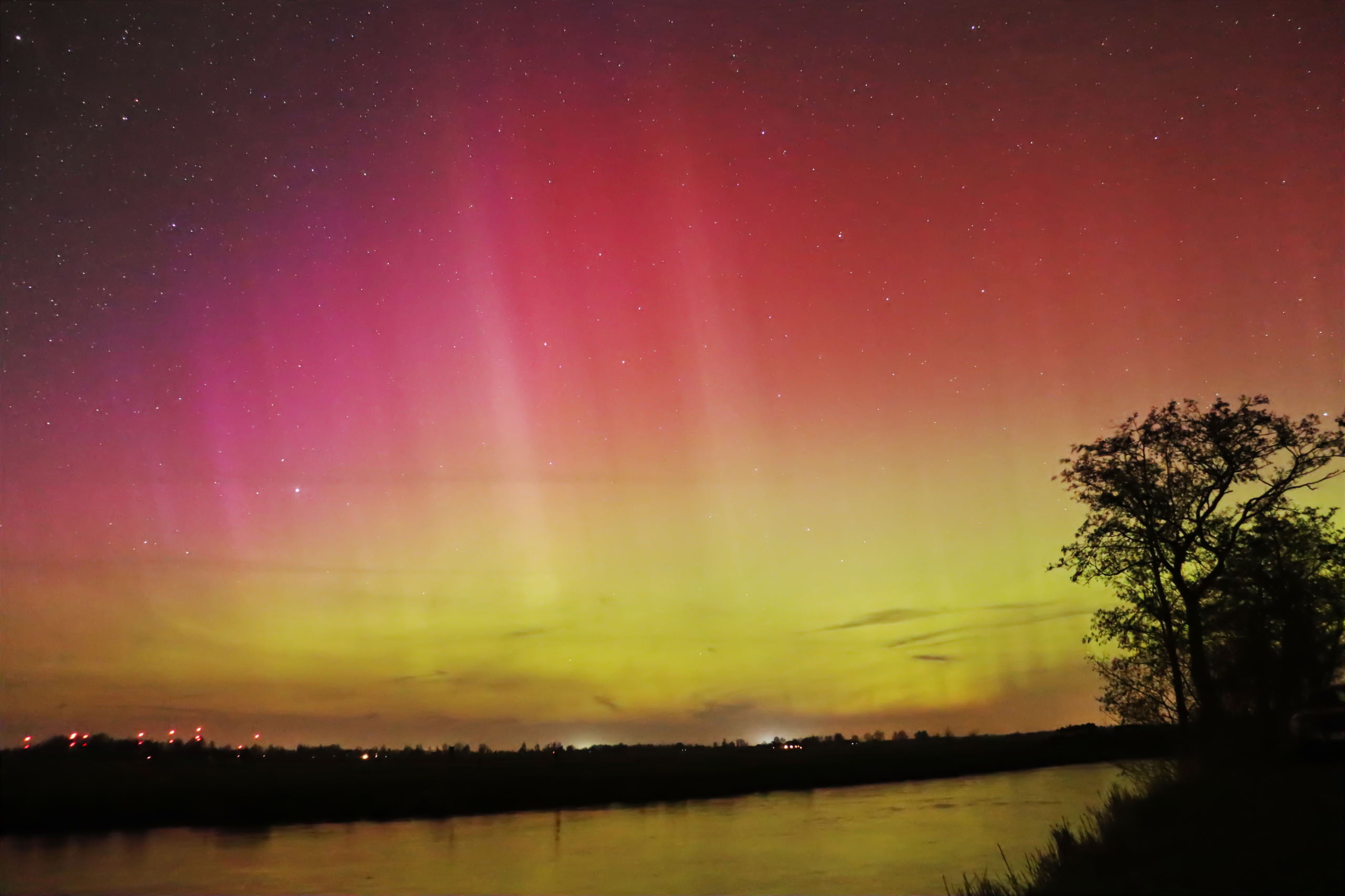
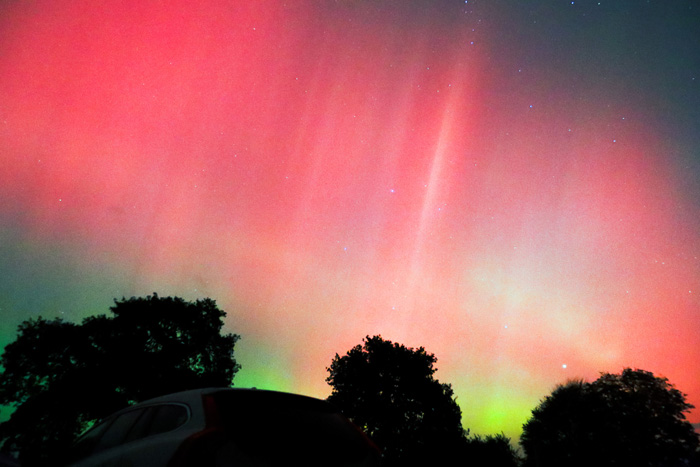
    Thursday night brought an unexpected highlight: northern lights. We had been alerted to a high KP index earlier in the day and as the first reports rolled in at dinner, we rushed back to our meeting place. The sky soon revealed a soft, reddish-green glow, forming a surreal backdrop for a presentation on constellation mythology. Slowly, the auroras transformed into a mesmerizing dance, their vibrant streaks weaving across the heavens. Captivated, I snapped photo after photo until clouds moved in, giving us a brief pause to sit and chat.

    Just as we thought the show was over, another wave of green and red lights appeared, this time brighter and stretching into the zenith. The sight was nothing short of magical—a perfect fusion of art and science. When the display finally faded, I had captured around 660 photos, which later became stunning time-lapse sequences.


    On Friday, we found time for solar observations. Using telescopes equipped with H-alpha filters, we marveled at sunspots and prominences. Later, a group ventured out to the fields in search of a clear view of the western horizon, hoping to spot Comet C/2023 A3. Unfortunately, low clouds made it hard to find the comet against the still light sky although Venus was clearly visible.

    Back at the meadow, many of us enjoyed casual conversations while others set up their equipment. As the night went on, the air grew heavy with humidity, making observations increasingly difficult. Jupiter and Saturn were once again in view through a Dobsonian, though the turbulent atmosphere made it impossible to see finer details. To lighten the mood, we joked about the music from a nearby party and decided to create our own festive atmosphere. Our „party“ featured leftover homemade liqueur and alcohol-soaked fruit, adding a humorous twist to the evening.


    Saturday featured a lecture by an astrophysicist from a neighboring club, exploring the origins and impacts of small celestial objects like comets and meteorites. That evening, the clouds parted briefly, allowing us to observe Jupiter, Saturn, and the Hercules Cluster. With rain in the forecast, many participants began packing up, and I decided to call it a night as well. This was the longest stay I’ve ever had at our star party, and the most time I’ve spent sleeping in my „mini-van“. My back was rather grateful for a normal bed that night xD

  • A magical summer night surprise

    A magical summer night surprise

    On the night of August 12th, the maximum of the Perseid meteor shower, I spontaneously went outside to catch some shooting stars. Little did I know, the night would hold an even more magical surprise.

    It was a clear night, and the Perseid meteors didn’t disappoint—bright, swift, and frequent. Equipped only with my smartphone, a Xiaomi Redmi Note 10 Pro, I tried to take long-exposure shots in hope to catch some shooting stars as they lit up the sky.

    While I caught satellite after satellite (nowadays it’s kinda hard to NOT catch one), I couldn’t capture a shooting star. Still I loved one of the images showing the bright milky way with its filigree dust clouds.

    I was so focused on the meteors that I hadn’t expected to see anything else unusual. But just after midnight, I got a notification from my astronomy group hinting that there might be northern lights visible.

    A photo of the milky way showing a satellite trail, Xiaomi Redmi Note 10 Pro, 18 mm, F1.9, 30 s, ISO 6400 (12.08.2024 23:39), single picture, PS5 and Nero AI Image Denoiser

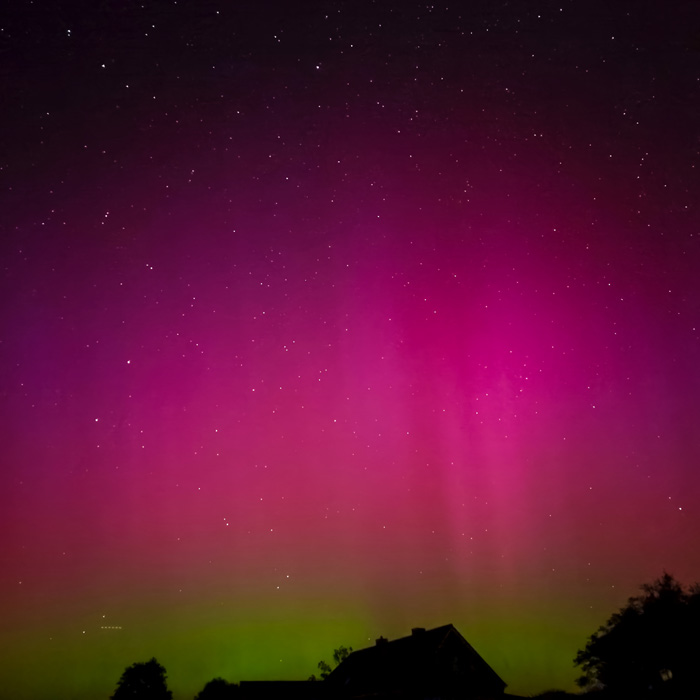
    Excited, I turned my attention northward, scanning the horizon for any signs. At first glance, the sky seemed its usual self, with nothing but faint, vertical lines that seemed a tad bit brighter than the sky. Yet something about them caught my curiosity.

    I took a few shots and, sure enough, my camera revealed what my eyes couldn’t quite see on their own—those faint streaks were indeed northern lights! Quickly I changed my place for a better view towards the north. Now my eyes could make out a sublte red and even a touch of green glowing across the horizon, adding a surreal beauty to the already magical night. The auroras remained faint, yet unmistakable in the photos. I watched as they danced quietly in the distance for around 40 minutes before fading away.

  • Aurora – the northern lights

    Aurora – the northern lights

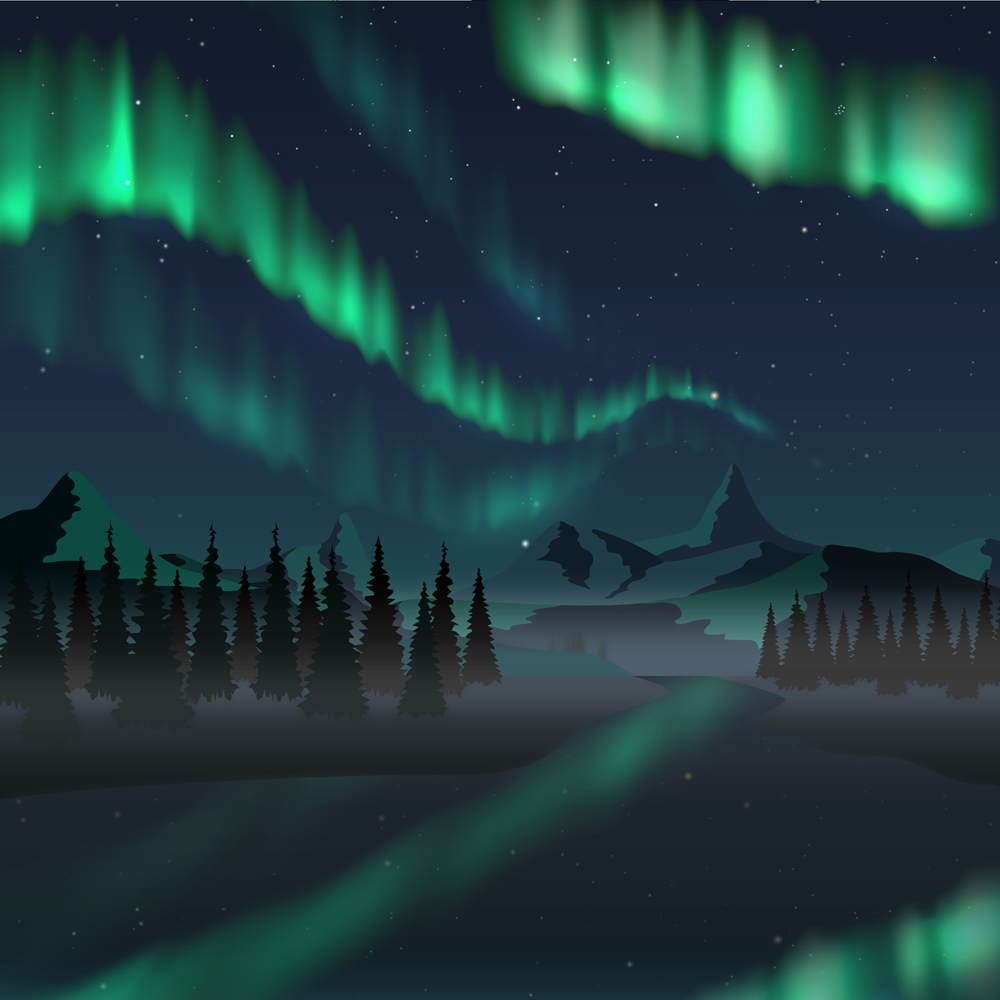
    The northern lights are always magical. So when I came across a tutorial beginning of 2022 I just had to try it. I didn’t quite like the mountains in the first version, they felt too plain. A while back I decided to rework them and I’m super pleased with how it turned out 🥰

    It’s also uploaded to my Redbubble shop and my new Society 6 shop so if you like it, make sure to head over and get a print of it (or some fancy accessoires 😄)

    Redbubble Shop:     Society 6 Shop: