

For months, August 12, 2026 had been a fixed point somewhere in the future. We had been planning, testing our equipment, discussing observing sites, weather, cameras and all the other things that seem important when you are preparing for a total solar eclipse.
Getting to Spain itself was stressful enough that I did not really feel like I had arrived until we finally reached our house in Moal.
The days before
My equipment for the eclipse was quite compact: I had my DWARF 3 with me, together with my Canon EOS M50 and a telephoto lens. Others in our group brought additional telescopes, including equipment for observing the Sun in H-alpha. The main challenge was obvious long before we arrived: this eclipse would happen extremely late in the day. Totality would take place shortly before sunset. Beautiful? Absolutely. But not particularly convenient with mountains all around you.
Fortunately, we had several days before the eclipse to check out potential observing spots. And we made good use of it.
On the first night two guys from our group decided to check out a local mountain. Of course I joined them. And we returned almost every night afterwards. We had wonderfully dark skies, watched plenty of Perseids and tested our equipment with varying degrees of success. On one particularly good night my DWARF 3 apparently decided that taking photos was optional… 😑 Other equipment had its own ideas as well like a phone that ended up as an involuntary folding model.
Despite all the equipment, the trip never felt like one long technical exercise. We spent a lot of time laughing, squeezing ourselves onto the back seat during our search for an observing location, exploring some of the surrounding landscape and developing a remarkably reliable method of gathering the entire group: offer slices of watermelon. That always worked.


Eclipsed
On eclipse day we decided to head to Puerto del Connio at an altitude of 1,315 m. We arrived around noon, so there was plenty of time to set up the equipment, talk to people and repeatedly look at the sky. Sometimes clouds rolled in and it got a bit cooler until the sun bore down on us again.
At 17:30 it started raining. We mostly looked at the tiny patches of cloud and wondered where the hell it had come from. I was still relaxed. What mattered more to us was the horizon and that was clear.
More and more people arrived during the afternoon and evening until roughly 200 eclipse watchers were scattered across the mountain. At 19:31, the Moon finally began moving across the Sun.
My DWARF 3 was running a timelapse while I manually took a photo with my Canon EOS M50 every few minutes. In between I talked to the people around me. For quite a while the eclipse itself progressed almost quietly, but surprisingly quickly. Meanwhile, we received photos from Germany, where the rest of our club was running their own eclipse event.
Then the surroundings began to change. It became noticeably cooler several minutes before totality. The light grew pale and increasingly strange. The crickets became extremely quiet. The people did not. As the remaining part of the Sun became thinner, the atmosphere on the mountain grew louder. People were cheering, shouting and whistling. Months of planning suddenly came down to the last few seconds before totality.
And that was when I managed to mess up the camera focus. While removing the solar filter from the Canon, I accidentally shifted the focus and could not find it again quickly enough. For a moment I was annoyed. This was exactly the photograph I had travelled more than 1,500 kilometres to take 😒
Instead I grabbed my phone and looked up.
103 seconds of darkness
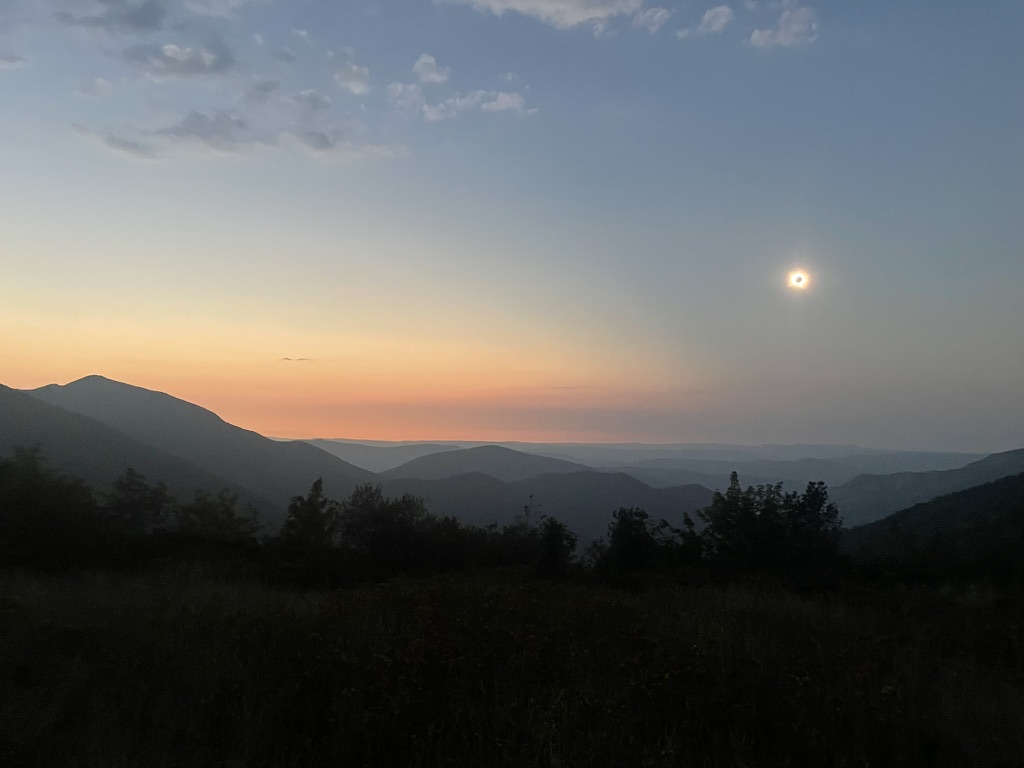
At 20:28, the Sun disappeared and the landscape changed completely:
The eclipsed Sun hung black above the mountains, surrounded by the corona, while the horizon still glowed in strange colours. Layer after layer of mountains faded into the distance, creating an incredible sense of depth beneath a sky that simply did not look real anymore.
The pale light, the colours above the horizon, the dark silhouette of the Moon and the noise of hundreds of people reacting at once were overwhelming.
I was absolutely blown away. My carefully considered professional description to a local newspaper was: “Absolut oberhammergeil.” That was about as accurate as I could make it 😆
And then the sunlight returned. A few of us quickly took a photo together afterwards, still wearing the kind of ridiculous happy faces that probably explained the experience better than any carefully written description could.


Back under the stars
The eclipse itself ended at 21:21, but our night did not. Some of the others stayed on the mountain while others went back to the house. I drove back to change clothes and fetch a few things, then I went straight up again. We placed some blankets on the ground and spent half the night lying under the stars and watching the Perseids. And there were some pretty bright ones!


By the next day we were appropriately destroyed. It was around 30 degrees and nobody had slept enough. Worth it!
We took it easy the next day, edited our photos and messaged friends in Germany. There were hundreds of photos and videos waiting to be reviewed, several cameras with very different results, stories from everyone in the group and far too many small moments that no photograph captured.
The timelapse with the DWARF had a major drawback: I had chosen intervals that were far too long so I had hardly any images from totality. The Canon images were not perfectly focused, but surprisingly usable.
The remaining days were much quieter. We went for short hikes or swam in a river whenever we got tired of chilling at the house. Of course we also went back up to Puerto del Connio and one night we still could take some photos.
Twenty-seven years later
I had already come close to seeing a total solar eclipse in 1999. I was 13 and stood with my parents in an open field in southern Germany. Just before totality, clouds moved in. That eclipse still had an impact: later that year, my parents gave me my first telescope. Twenty-seven years later, standing in Asturias with my own cameras and equipment, I finally got to see what the clouds had hidden from me back then.
And apparently, one totality was not enough. We have already booked the next one: Tunisia, 2027.