
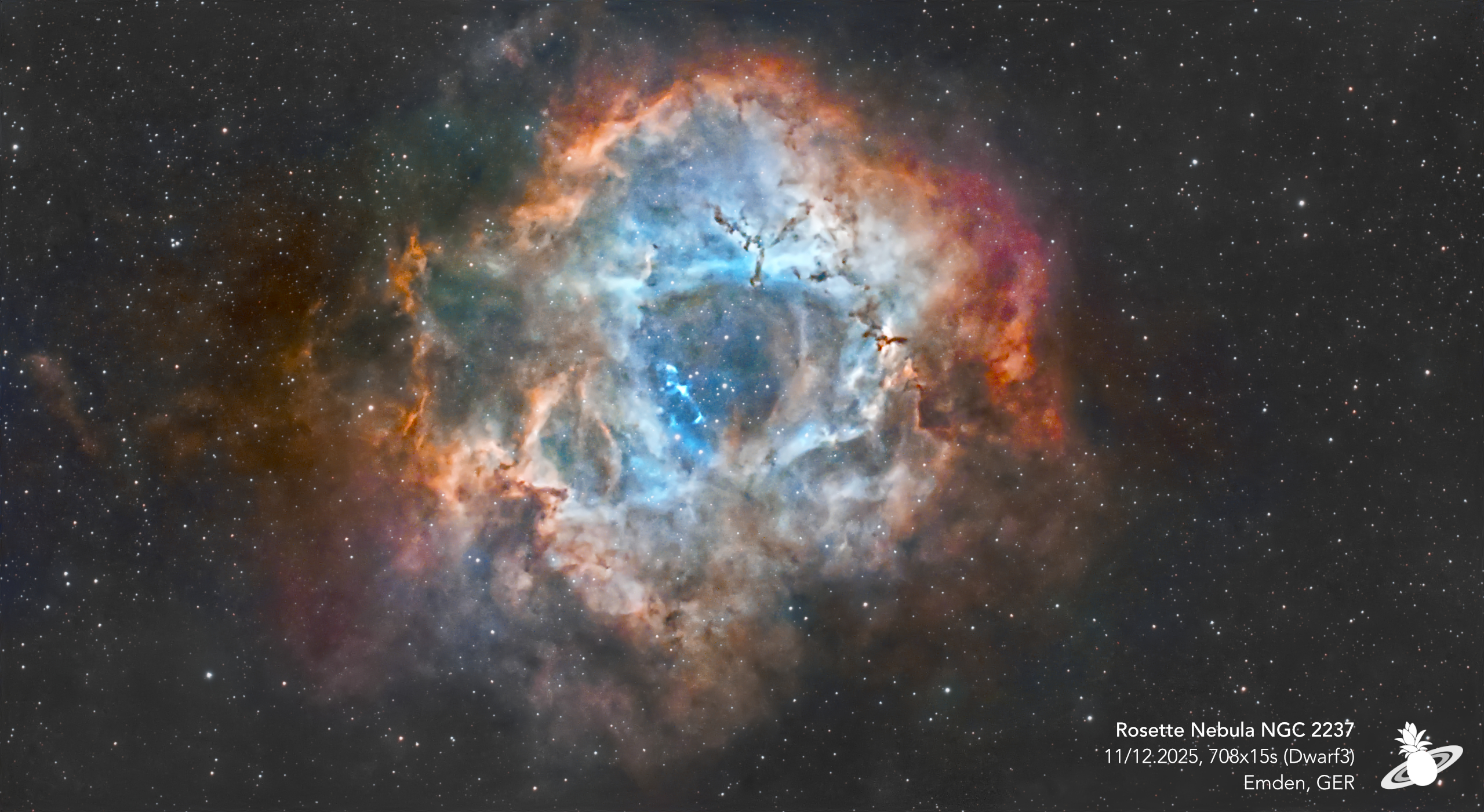
Over several nights in November and December 2025, I collected 708 exposures of the Rosette Nebula with the DWARF 3. At 15 seconds each, that adds up to almost three hours of total integration time.
The data itself was processed in a fairly familiar way at first. I calibrated, registered and stacked the individual lights in Siril, removed gradients with GraXpert, then returned to Siril for colour calibration, star removal and stretching. The final adjustments were done in Affinity Photo.
The interesting part started with the colour: My first versions were mostly red, which is of course what you would expect from the strong hydrogen emission in this region. But I wasn’t particularly happy with it. With everything sitting in similar shades of red and magenta, I found it much harder to separate the different structures and create enough contrast between the brighter gas, darker dust lanes and the more delicate parts of the nebula.
Although I’ve been interested in astronomy for a long time, I’m still relatively new to deep-sky image processing. So a lot of this is still experimentation for me: trying different approaches, seeing what works and slowly figuring out which techniques suit both the data and the kind of look I want to achieve.
The final image uses a pseudo-SHO-style colour palette rather than a natural RGB look. Getting there involved quite a bit of trial and error in Siril and somewhere along the way the colours slowly started to fall into place. The centre moved towards blue and cyan, warmer tones remained around the outer regions, and the different structures became much easier to distinguish from each other.
I wish I could tell you exactly which combination of steps finally did the trick. I can’t.
Apparently, “this looks interesting, let’s try that” is not a particularly useful processing log 😅
So this image also comes with a small note to my future self: when an experiment starts working, write down what you actually did.
What I like most about the finished version is that the Rosette no longer reads as one large red cloud. The darker structures inside the nebula become much more obvious, the central cavity stands out more clearly and the surrounding gas shows a lot more variation than I could get from my earlier red versions.