
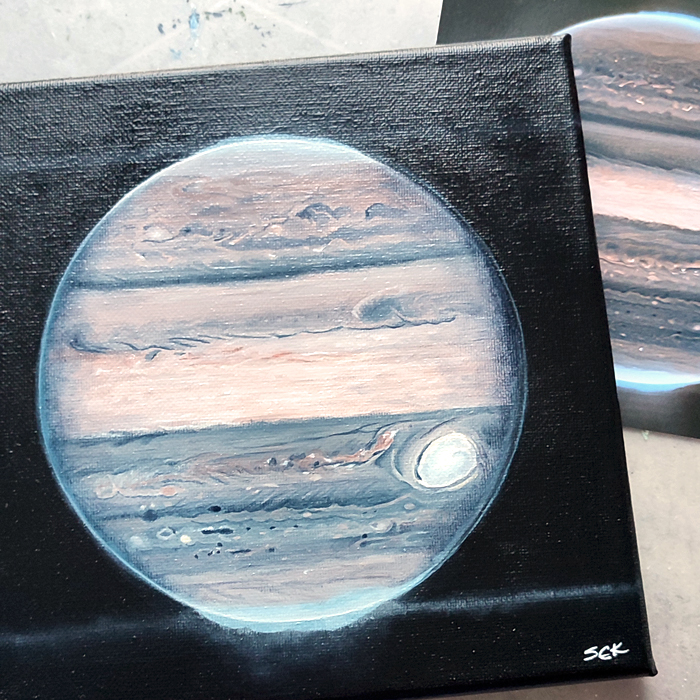
This acrylic painting on canvas was inspired by the breathtaking false-color image of Jupiter captured by the James Webb Space Telescope. The original composite image, based on NASA NIRCam data, shows the giant planet in a way we could never see with our own eyes: glowing auroras around both poles, atmospheric hazes, swirling cloud bands and the famous Great Red Spot.
In this infrared view, brightness tells us something about altitude. High clouds and hazes appear brighter, which is why the Great Red Spot, Jupiter’s iconic storm system that has been observed for centuries, appears almost white. Lower cloud layers appear darker and blue, giving the planet this mysterious, dreamlike look.
That contrast fascinated me: a scientific image that feels almost like abstract art. I wanted to translate Jupiter’s strange infrared beauty into acrylic paint, keeping the movement, depth and luminous atmosphere of the original while letting it become its own artwork.
The painting process was challenging, especially because of the soft transitions and swirling structures in Jupiter’s atmosphere. But honestly? It was also a lot of fun. There is something wonderfully strange about painting a planet that is familiar and completely alien at the same time.
I’m really pleased with how this Jupiter painting turned out. Let me know in the comments what you think — or if you have any questions about the artwork, the process or the James Webb image that inspired it.
Image inspiration / photo credit: NASA Webb, ESA Webb, CSA, Jupiter ERS Team, with image processing by Ricardo Hueso and Judy Schmidt.